31 full-time faculty, eight research clusters, ABET-accredited bachelor's programs, and master's and doctoral degrees in electrical and computer engineering, at a Carnegie R1 university in the Massachusetts high-tech corridor.
Electrical and Computer Engineering (ECE) offers a diverse curriculum at both the undergraduate and graduate levels. Our experienced faculty have active research programs in areas including: nanotechnology, computer architecture, power distribution and more.
We offer degrees in both Electrical Engineering and Computer Engineering at the bachelor, masters and doctoral levels. Both bachelor's programs are accredited by the Engineering Accreditation Commission of ABET.
ECE offers degrees in electrical engineering and computer engineering at the bachelor's, master's and doctoral levels. Both bachelor's programs are accredited by the Engineering Accreditation Commission of ABET.
A broad core of undergraduate courses in both majors leads into a large set of advanced graduate courses, and hands-on lab work runs through the undergraduate years up to the senior capstone. See all programs.
Who We Are
The department has 653 undergraduate and 177 graduate students (fall 2026) and 31 full-time faculty: 25 tenured or tenure-track and 6 teaching. Their internationally recognized research covers computational electromagnetics, photonics, computer engineering, nanomaterials, renewable energy, VLSI design, control theory, biosensors and image processing.
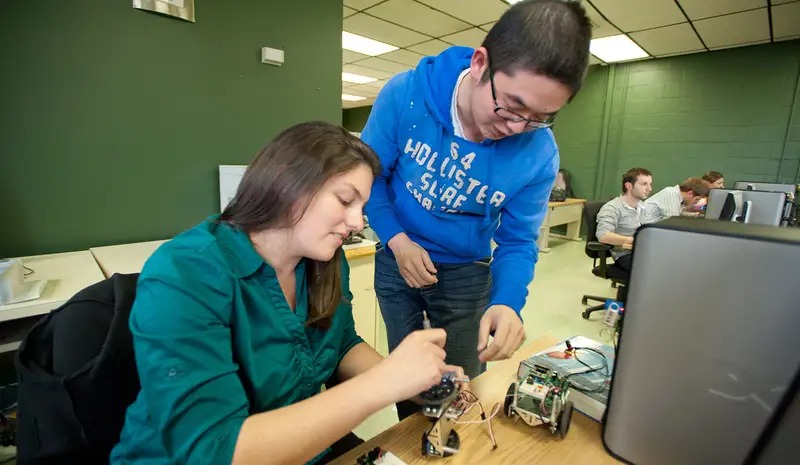
Through the Assistive Technology Program, senior capstone teams design and build custom devices for clients with disabilities. The program has delivered more than 1,500 products to local agencies and their clients.
ECE works closely with the companies that hire our graduates to keep the curriculum relevant, including through the Industrial Advisory Board, which meets every semester.
Our place in the Massachusetts high-tech corridor gives students many chances for co-ops, internships and part-time and summer jobs. See where our students work.
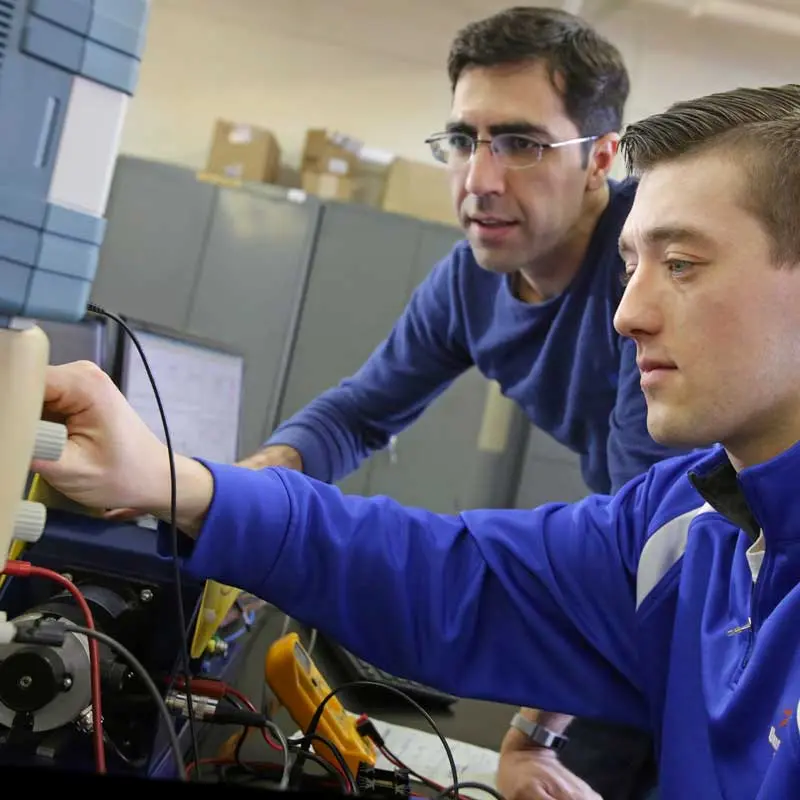
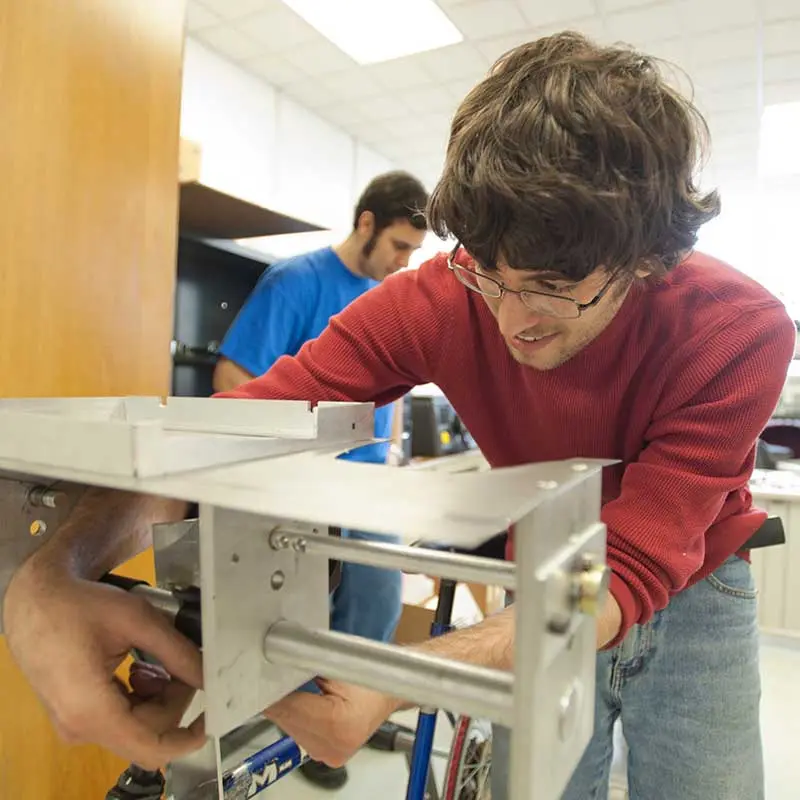
The ECE Department mission for undergraduate education is to provide a thorough grounding in electrical science, electrical engineering and computer engineering, together with intensive training in mathematics. The techniques of experimental science and technology are emphasized through investigative laboratory work and classroom lecture and demonstrations.
The ECE Department's mission for undergraduate education is to provide a thorough grounding in electrical science, electrical engineering and computer engineering combined with intensive training in mathematics. Experimental science and technology are emphasized through investigative laboratory work and classroom lectures and demonstrations.
Technical electives, double majors and a real project for a client
The curriculum includes engineering science and design courses that give a balanced view of hardware, software, application trade-offs, basic modeling techniques and the use of computer-aided design tools. These principles run through the whole curriculum, which encourages students to take on major and meaningful design experiences.
Part of the curriculum is devoted to the humanities and social sciences, with a wide choice of subjects. These general education courses broaden students' outlook and show how much non-technical knowledge shapes an engineer's responsibilities in professional life.
An important part of the curriculum is the senior-year technical elective program. Technical electives let students broaden or deepen their technical knowledge according to their interests. Tracks focused on computing skills and double majors in computer science and physics are also offered.
The project-based capstone brings together knowledge from several courses to solve a real engineering problem, often for a client with a disability. Many electronic and microprocessor-based systems delivered this way have made a major difference to the freedom and quality of life of their users. See senior capstone projects. The department also works with many local companies, large and small, to offer co-ops that can earn course credit.
The department has responded to industry needs with focused programs at the undergraduate and graduate levels, to develop technically literate engineers of value to the community. Graduates are knowledgeable, practical problem solvers, and most of them stay in New England as working engineers. The co-op program, formalized with the college and the university, adds relevance to courses and exposure to working professionals.
The Industrial Advisory Board helps the department review program objectives against current industry needs, and its input is used to keep checking how relevant the curriculum is. Those needs are balanced against the fundamentals that serve students well over the long term. Technical areas sometimes take second place to a can-do attitude, strong communication skills and the initiative to keep learning.
The board meets once per semester. Close ties with industry through co-ops, research, consulting and alumni give the department steady feedback on the skills graduates need at work.
The department's primary focus is undergraduate education, and its graduate program builds on the strengths of the faculty. Faculty work closely with local and regional industry through consulting and research, advise graduate students from regional companies, and take part in local and national professional societies.
Most ECE students go into industry, and a significant share find positions with companies within 100 miles of Lowell. Some go straight to graduate school, and many continue their graduate study later with support from their employers.
The department takes part in the Graduate Master's Co-op Option in Engineering. For eligibility, curriculum requirements, dates and how to apply, see the Graduate Catalog co-op page.
ABET accredited. The Electrical Engineering program is accredited by the Engineering Accreditation Commission of ABET under the commission's General Criteria and Program Criteria for Electrical Engineering. The Computer Engineering program is accredited by the Engineering Accreditation Commission of ABET under the General Criteria and Program Criteria for Computer Engineering.
Advising
Every undergraduate is assigned a faculty advisor, and students must meet with their advisor during registration and whenever a concern comes up. Advisors help each student find the best path through each track, which matters most for co-op and part-time students who need to keep prerequisites in order. The ECE advising site has forms and answers to common questions.
Seniors take technical electives, three in electrical engineering and two in computer engineering, chosen from ECE courses numbered EECE.4xxx or EECE.5xxx that are not otherwise required. For ideas, see the research clusters.
General Education
Students take three social science courses, one of them Principles of Microeconomics or Macroeconomics, and three arts and humanities courses, one of them Engineering Ethics (PHIL.2410). For course descriptions, degree pathways and more, see the UMass Lowell undergraduate catalog.
Program Educational Objectives
Our Program Educational Objectives describe what we expect of our graduates after several years of work.
Be established and recognized as a valued professional and an effective communicator in industries related to electrical, computer and electronic technologies.
Practice their profession in a collaborative, team-oriented manner that embraces the multidisciplinary and multicultural environment of today's business world.
Engage in lifelong learning and professional development via post graduate education and participation in professional organizations.
Function as a responsible member of society with willingness to mentor fellow employees and an understanding of the ethical, social and economic impact of their work in a global context.
Student Outcomes
The Computer Engineering and Electrical Engineering programs have adopted the ABET Criterion 3 student outcomes, so that at graduation students are expected to have:
an ability to identify, formulate, and solve complex engineering problems by applying principles of engineering, science, and mathematics
an ability to apply engineering design to produce solutions that meet specified needs with consideration of public health, safety, and welfare, as well as global, cultural, social, environmental, and economic factors
an ability to communicate effectively with a range of audiences
an ability to recognize ethical and professional responsibilities in engineering situations and make informed judgments, which must consider the impact of engineering solutions in global, economic, environmental, and societal contexts
an ability to function effectively on a team whose members together provide leadership, create a collaborative and inclusive environment, establish goals, plan tasks, and meet objectives
an ability to develop and conduct appropriate experimentation, analyze and interpret data, and use engineering judgment to draw conclusions
an ability to acquire and apply new knowledge as needed, using appropriate learning strategies.
Bachelor of Science in Engineering in Electrical Engineering
UMass Lowell's electrical engineering major prepares you to design and build the technologies that power today’s world.
Develop a strong foundation in math, science and engineering.
Gain hands-on experience in areas such as circuits, systems, hardware, software and design.
Labs, demonstrations and project-based learning help you turn theory into practical skills.
The senior-year technical elective program is designed to deepen technical knowledge based on your interests. In addition, the project-based capstone experience will challenge you to develop a custom-designed product for a client with a disability through the Assistive Technology Program.
With ABET accreditation and a curriculum that combines technical depth with professional preparation, you'll graduate ready for what’s next.
Double Major
Combine electrical engineering with computer science or physics while completing a single degree.
Median annual salary for bachelor's degree holders in New England Source: Lightcast, 2025
+8.5%
Projected job growth in New England (2023–2035) Source: Lightcast, 2025
What Can You Do with a Degree in Electrical Engineering?
As an electrical engineering graduate, you'll gain the necessary fundamentals of electrical engineering to launch a successful career in industry or continue on to graduate school.
2A grade of C or better in Calculus II is required
3Technical electives are non-required courses numbered EECE.4xxx or EECE.5xxx.
4Electrical Engineering students meet the Core Curriculum Essential Learning Outcome of Diversity and Cultural Awareness (DCA) outside of the major. See the DCA course listing for a complete list of options.
No more than two Breadth of Knowledge (BOK) courses can be taken with the same prefix. The Core Curriculum courses may be taken in any sequence. Refer to the Core Curriculum policy for further details. You should meet with your faculty advisor to determine how you will meet the Core Curriculum requirements.
Current UMass Lowell students should use their Advisement Report in SIS. If you need assistance, please contact your adviser.
Restriction on off-campus study:
Be advised that any course taken at another institution must be formally approved prior to enrollment. See the catalog policy for details.
Breadth of Knowledge (BOK) Glossary
SS - Social Sciences Perspective - 9 credits
AH - Arts and Humanities Perspective - 9 credits
SCL - Sciences with Lab Perspective - 6-8 credits
STEM - Science, Technology, Engineering and Math Perspective - 3 credits
2A grade of C or better in Calculus II is required.
3Electrical Engineering & Computer Science students meet the Core Curriculum Essential Learning Outcome of Diversity and Cultural Awareness (DCA) outside of the major. See the DCA course listing for a complete list of options.
No more than two Breadth of Knowledge (BOK) courses can be taken with the same prefix. The Core Curriculum courses may be taken in any sequence. Refer to the Core Curriculum policy for further details. You should meet with your faculty advisor to determine how you will meet the Core Curriculum requirements.
Current UMass Lowell students should use their Advisement Report in SIS. If you need assistance, please contact your advisor.
Restriction on off-campus study:
Be advised that any course taken at another institution must be formally approved prior to enrollment. See the catalog policy for details.
Breadth of Knowledge (BOK) Glossary
SS - Social Sciences Perspective - 9 credits
AH - Arts and Humanities Perspective - 9 credits
SCL - Sciences with Lab Perspective - 6-8 credits
STEM - Science, Technology, Engineering and Math Perspective - 3 credits
2A grade of C or better in Calculus II is required.
3PHYS.3380 Optics and Waves satisfies the prerequisite for PHYS.5390 Electro-Optics, a core course in the Optical Sciences option for the M.S. in Physics.
4EECE.5680 Electro-Optic Systems, also offered as EECE.4680, satisfies an elective course in the Optical Sciences option for the M.S. in Physics.
5Electrical Engineering & Physics students meet the Core Curriculum Essential Learning Outcome of Diversity and Cultural Awareness (DCA) outside of the major. See the DCA course listing for a complete list of options.
No more than two Breadth of Knowledge (BOK) courses can be taken with the same prefix. The Core Curriculum courses may be taken in any sequence. Refer to the Core Curriculum policy for further details. You should meet with your faculty advisor to determine how you will meet the Core Curriculum requirements.
Current UMass Lowell students should use their Advisement Report in SIS. If you need assistance, please contact your advisor.
Restriction on off-campus study:
Be advised that any course taken at another institution must be formally approved prior to enrollment. See the catalog policy for details.
Breadth of Knowledge (BOK) Glossary
SS - Social Sciences Perspective - 9 credits
AH - Arts and Humanities Perspective - 9 credits
SCL - Sciences with Lab Perspective - 6-8 credits
STEM - Science, Technology, Engineering and Math Perspective - 3 credits
Work closely with renowned faculty and graduate students on groundbreaking research in areas such as:
Control systems
Digital signal processing
Microwave technology
Electromagnetics
Optoeletronic and optical devices and systems
Power systems
Telecommunications
Wireless communications
Career Connected Experience: The UMass Lowell Guarantee
Every first-time, first-year UMass Lowell student will have the opportunity to pursue at least one Career Connected Experience (internships, co-ops, clinical placements, service learning, study abroad and more) during their undergraduate career — earning pay, credits or both before they graduate.
Bachelor of Science in Engineering in Computer Engineering
Build expertise in embedded hardware and software, distributed and stand-alone computing systems and computer networks through UMass Lowell’s ABET-accredited computer engineering major.
Take courses in engineering science and design
Gain a strong foundation in hardware, software, modeling and computer-aided design
Deepen your understanding of the ethical and professional responsibilities that shape engineering practice with courses in the humanities and social sciences
A key part of the curriculum is the senior-year technical elective program, which lets you deepen your expertise in your areas of interest. As a senior, you can also complete a hands-on capstone project through the Assistive Technology Program, designing a custom product for a client with a disability.
Career Outlook for Computer Engineering Majors
$133K
Median annual salary for bachelor's degree holders in New England Source: Lightcast, 2025
+12.9%
Projected job growth in New England (2023–2035) Source: Lightcast, 2025
What Can You Do with a Degree in Computer Engineering?
UMass Lowell computer engineering graduates use their knowledge to create devices and systems that address needs in areas including health and welfare, safety, environmental control and knowledge enhancement.
Where Our Graduates Work
Amazon Robotics
Analog Devices
BAE Systems
Bose Corp.
Eversource
Hanscom Air Force Base
Intel
iRobot
National Grid
Raytheon Technologies
Computer Engineering Courses You'll Take
Sample course topics include:
Electrical and Computer Engineering Applications Programming
2A grade of C or better in Calculus II is required.
3Technical electives are non-required courses numbered EECE.4xxx or EECE.5xxx.
4Computer Engineering students meet the Core Curriculum Essential Learning Outcome of Diversity and Cultural Awareness (DCA) outside of the major. See the DCA course listing for a complete list of options.
No more than two Breadth of Knowledge (BOK) courses can be taken with the same prefix. The Core Curriculum courses may be taken in any sequence. Refer to the Core Curriculum policy for further details. You should meet with your faculty advisor to determine how you will meet the Core Curriculum requirements.
Current UMass Lowell students should use their Advisement Report in SIS. If you need assistance, please contact your advisor.
Restriction on off-campus study:
Be advised that any course taken at another institution must be formally approved prior to enrollment. See the catalog policy for details.
Breadth of Knowledge (BOK) Glossary
SS - Social Sciences Perspective - 9 credits
AH - Arts and Humanities Perspective - 9 credits
SCL - Sciences with Lab Perspective - 6-8 credits
STEM - Science, Technology, Engineering and Math Perspective - 3 credits
The Institute of Electrical and Electronic Engineering (IEEE)
IEEE Eta Kappa Nu - Epsilon Zeta Chapter
Interested in Video Game Design?
Learn how you can combine programs to prepare for the fast-growing video game industry.
Career Connected Experience: The UMass Lowell Guarantee
Every first-time, first-year UMass Lowell student will have the opportunity to pursue at least one Career Connected Experience (internships, co-ops, clinical placements, service learning, study abroad and more) during their undergraduate career — earning pay, credits or both before they graduate.
Learn the fundamentals of both electrical engineering and computer science while completing a single degree.
Engineering students who wish to take on a second major that is offered by the College of Engineering or by another college must formalize this intent by the start of the junior year.
2A grade of C or better in Calculus II is required.
3Electrical Engineering & Computer Science students meet the Core Curriculum Essential Learning Outcome of Diversity and Cultural Awareness (DCA) outside of the major. See the DCA course listing for a complete list of options.
No more than two Breadth of Knowledge (BOK) courses can be taken with the same prefix. The Core Curriculum courses may be taken in any sequence. Refer to the Core Curriculum policy for further details. You should meet with your faculty advisor to determine how you will meet the Core Curriculum requirements.
Current UMass Lowell students should use their Advisement Report in SIS. If you need assistance, please contact your advisor.
Restriction on off-campus study:
Be advised that any course taken at another institution must be formally approved prior to enrollment. See the catalog policy for details.
Breadth of Knowledge (BOK) Glossary
SS - Social Sciences Perspective - 9 credits
AH - Arts and Humanities Perspective - 9 credits
SCL - Sciences with Lab Perspective - 6-8 credits
STEM - Science, Technology, Engineering and Math Perspective - 3 credits
With UMass Lowell’s Electrical Engineering and Physics double major, you will build a strong foundation in both fields to prepare for careers in technology, research or graduate studies.
Engineering students who wish to take on a second major that is offered by the College of Engineering or by another college must formalize this intent by the start of the junior year.
2A grade of C or better in Calculus II is required.
3PHYS.3380 Optics and Waves satisfies the prerequisite for PHYS.5390 Electro-Optics, a core course in the Optical Sciences option for the M.S. in Physics.
4EECE.5680 Electro-Optic Systems, also offered as EECE.4680, satisfies an elective course in the Optical Sciences option for the M.S. in Physics.
5Electrical Engineering & Physics students meet the Core Curriculum Essential Learning Outcome of Diversity and Cultural Awareness (DCA) outside of the major. See the DCA course listing for a complete list of options.
No more than two Breadth of Knowledge (BOK) courses can be taken with the same prefix. The Core Curriculum courses may be taken in any sequence. Refer to the Core Curriculum policy for further details. You should meet with your faculty advisor to determine how you will meet the Core Curriculum requirements.
Current UMass Lowell students should use their Advisement Report in SIS. If you need assistance, please contact your advisor.
Restriction on off-campus study:
Be advised that any course taken at another institution must be formally approved prior to enrollment. See the catalog policy for details.
Breadth of Knowledge (BOK) Glossary
SS - Social Sciences Perspective - 9 credits
AH - Arts and Humanities Perspective - 9 credits
SCL - Sciences with Lab Perspective - 6-8 credits
STEM - Science, Technology, Engineering and Math Perspective - 3 credits
Outstanding undergraduates can earn a combined Bachelor of Science and Master of Science in electrical or computer engineering, finishing both degrees by the fifth year.
How It Works
Take two graduate courses as a senior
Take two 5000-level graduate courses as your senior technical electives. With a B or better, they count toward both degrees.
Commit by the end of senior year
Commit to the B.S. Eng./M.S. Eng. program before the end of your senior year.
Finish both degrees
Receive the B.S. in Engineering at the end of year four and the M.S. in Engineering by the end of year five.
Students must meet all the requirements of the ECE Department and Graduate Admissions. Setting goals early with your advisor lets you plan prerequisites and required courses in sequence, which saves a considerable amount of time.
ECE prepares students for careers in artificial intelligence, robotics, electrical and electronic systems, communication and computer networks, and power and energy systems. Our graduates are in high demand and are hired by more than 100 leading companies.
#1
Public university in Massachusetts, WSJ/College Pulse 2026
Reputation.No. 1 public university in Massachusetts in the Wall Street Journal/College Pulse 2026 Best Colleges, with affordable tuition, a high employment rate and high-quality graduates.
Location. In the heart of the Massachusetts technology belt, with many companies within 45 minutes offering co-op, full-time and part-time jobs.
Artificial intelligence and roboticsManufacturing, drones, robot vacuums, lawn mowers, the internet
Communication systemsCell phones, GPS, navigation systems, teleconferencing
Computer systems and networksMicroprocessors, embedded systems, digital networks, cloud storage, game consoles
Control systemsEvery automated system: vehicles, drones, spacecraft, robots, satellites, appliances
Power and energyPower grids, smart grids, solar panels, wind turbines, generators, power supplies
RF and microwaveWireless communications, GPS, MRI scanners, cancer treatment, microwave ovens
Signal and image processingMedical imaging, machine vision, facial recognition, object detection, audio
Undergraduates and graduate students alike can join faculty-led research projects. Our graduates design, test, analyze, optimize and manufacture products, write software for countless applications, and some become college faculty themselves.
Advanced Lab Facilities
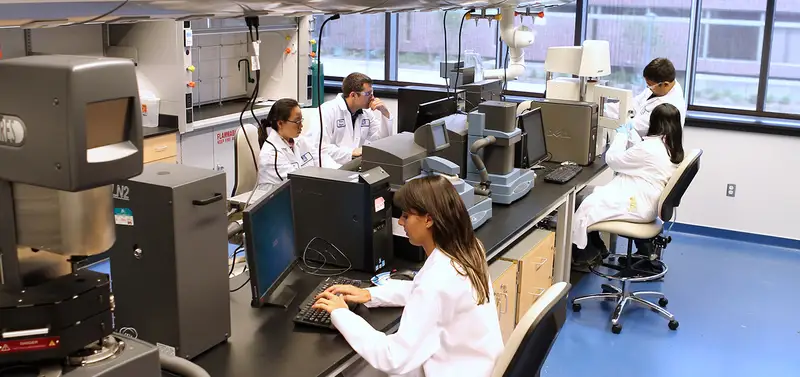
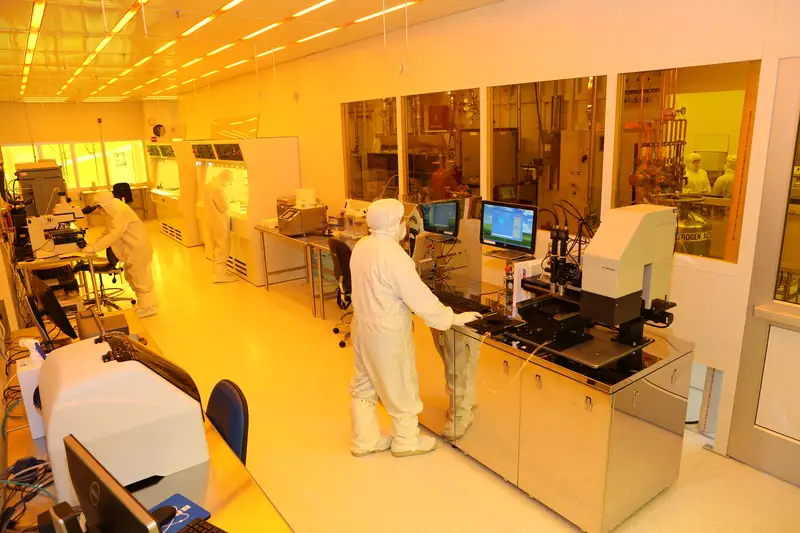
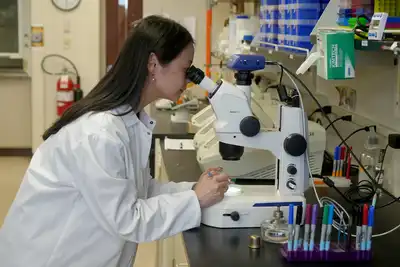
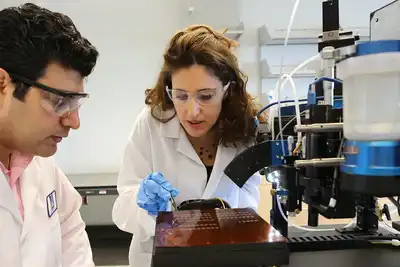
Teaching labs support four core lab courses: Circuits I and II and Electronics I and II. In each lab section, every student works independently with a full set of test equipment: an oscilloscope, a signal generator, a power supply and a computer. Every student also gets a parts kit to keep, with components, wire, a handheld multimeter and a breadboard.
Many other courses add lab, programming or software work, including Intro to ECE, Logic Design, ECE Application Programming, Microprocessors I and II, Advanced Digital System Design and Computer Vision. The 759-square-foot ECE stockroom next to the electronics labs stocks components, wire, bench equipment and soldering gear, and students can browse and order parts through the Stockroom App. Students also have access to the college's Lawrence Lin MakerSpace.
Capstone Projects
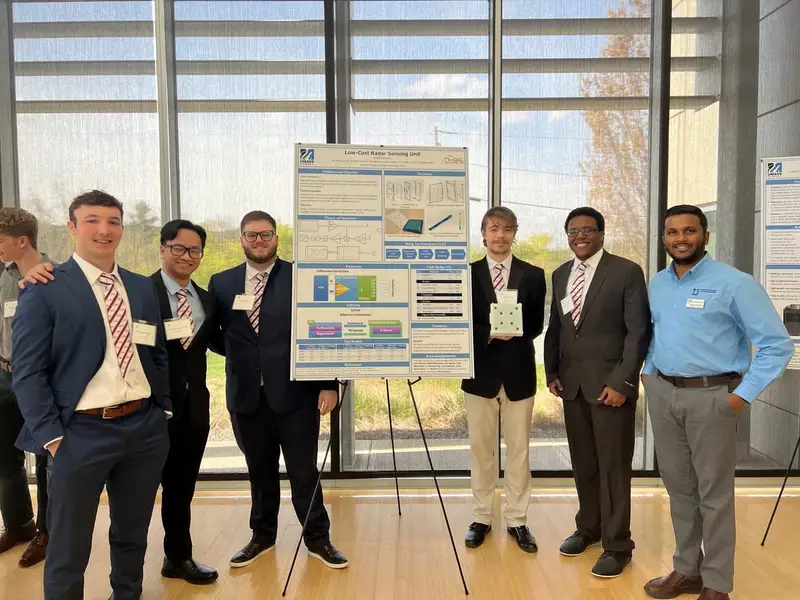
Seniors take a two-semester capstone sequence. In the first semester each team defines its project: requirements, a test plan, preliminary hardware and software designs and cost estimates. In the second, they verify and refine the design, then build, test and deliver the system to the client. Teams meet their mentors every week.
Engineering track
EECE.3991 and EECE.4991. Teams build assistive technology for people with disabilities, industry-sponsored projects with companies such as Raytheon and Brooks Automation, faculty-sponsored projects, and competition entries such as the DOE Collegiate Wind Competition and Formula SAE.
Entrepreneurship track
ENGN.4017 with the Manning School of Business, alongside ENTR.4960. Mixed teams of engineering and business students test a new product idea, then the engineers build the prototype in EECE.4991.
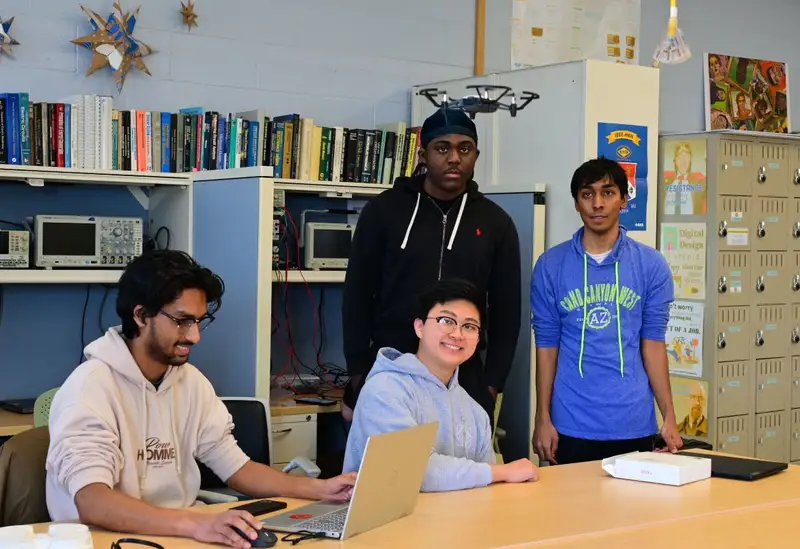
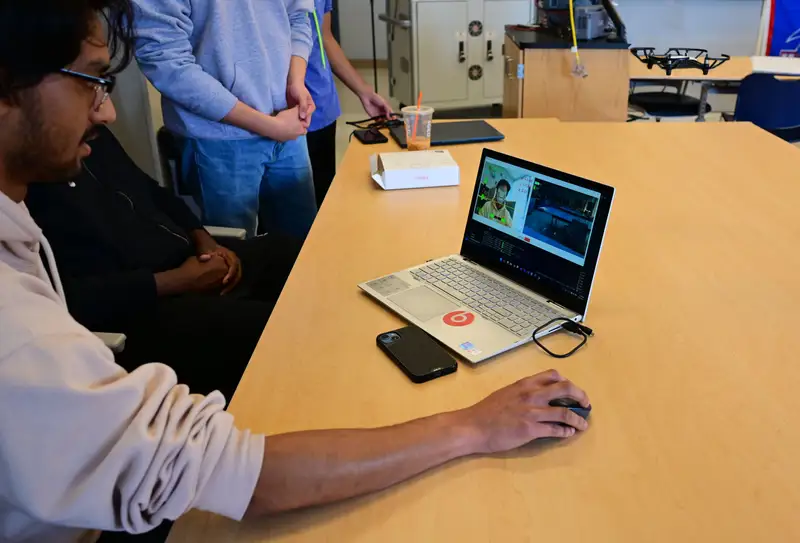
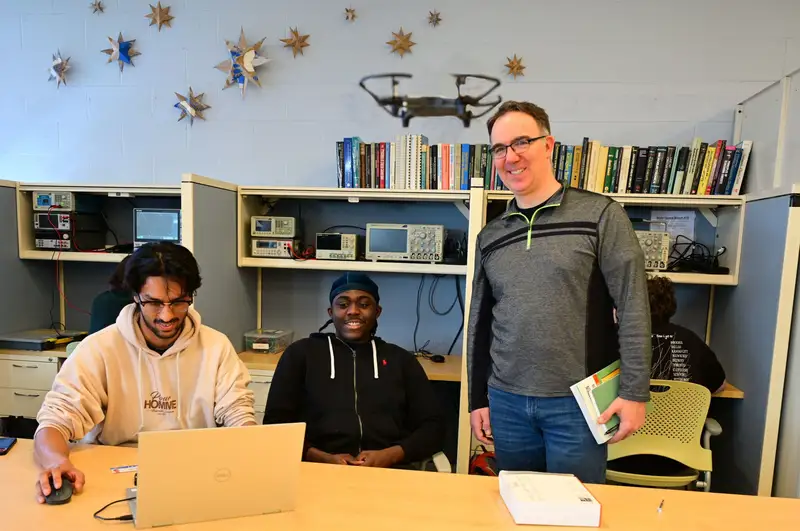
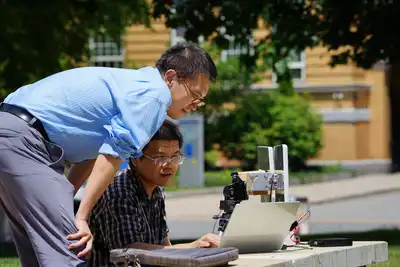
A capstone team controls a drone with head motion captured by a laptop camera.Professor Oshadha Ranasingha and his capstone team after their final presentation.
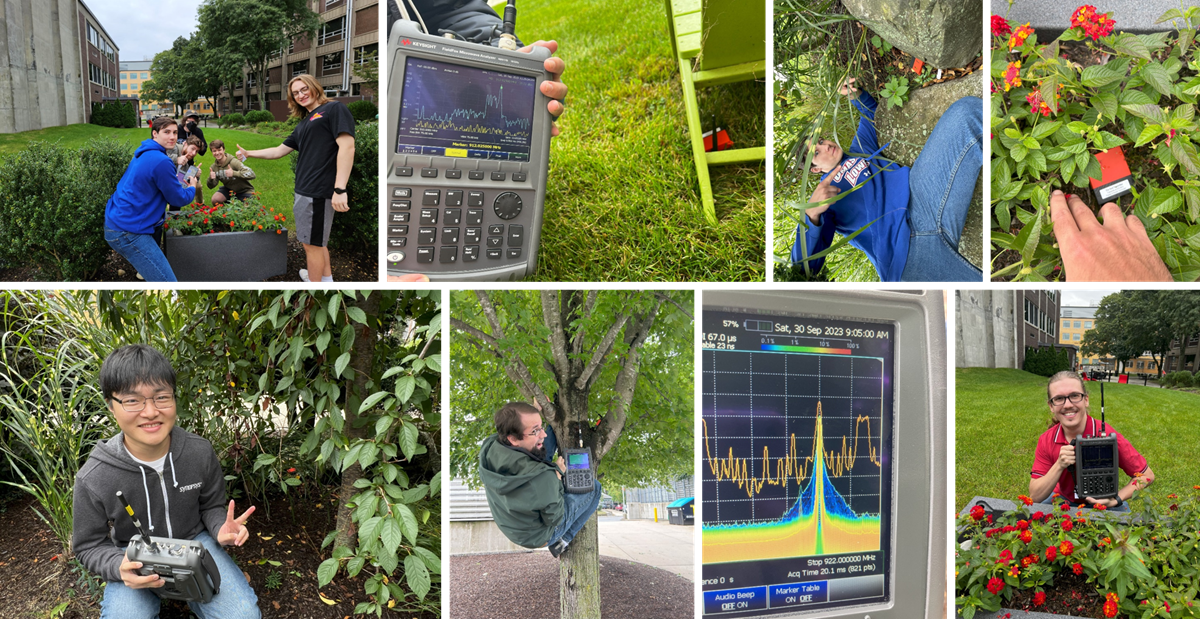
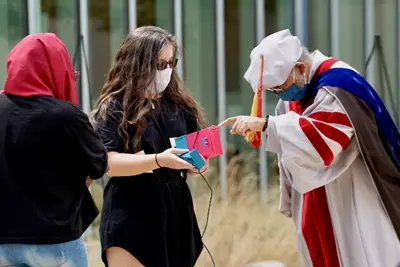
The department also hosts its own events each semester. In the Fox Hunt, teams used a microwave analyzer to track down red "foxes" hidden around campus: under a rock, in a flowerbed, in a tree. See all student clubs.
Where Our Graduates Work
More than 160 companies have hired our students and graduates, from Analog Devices, BAE Systems and RTX to MIT Lincoln Laboratory, Draper and Red Hat. Search the full list.
The department offers graduate programs leading to the Master of Science and Doctor of Philosophy. Our research is funded by the National Science Foundation, the Air Force Office of Scientific Research, the Defense Advanced Research Projects Agency, the Office of Naval Research and companies including Raytheon and Intel.
Our Master of Science in Engineering in Electrical Engineering (MSE) will deepen your knowledge in areas such as signal processing, communications, power systems and electronics. You can specialize this degree program by selecting from multiple concentrations in telecommunications, communications engineering, power and energy engineering, opto-electronics and more.
The program offers a blend of theoretical and hands-on learning, preparing you for advanced responsibilities in industry or further academic research. Research funders include the National Science Foundation, the Air Force Office of Scientific Research, the Defense Advanced Research Projects Agency, the Office of Naval Research and various companies, including Raytheon and Intel.
Program Quick Facts
No GRE Required
High Return on Investment
Scholarships and Financial Aid Available
STEM-Designated Degree Program
Master's in Electrical Engineering Curriculum
The MSE in Electrical Engineering is a 30-credit master's degree. Graduate students can choose to complete a thesis or non-thesis option.
Concentrations
Information Systems (Telecommunications)
Information Systems (Communications Engineering)
Power and Energy Engineering
Opto-Electronics
Other*
For a complete list of courses and academic requirements, please visit the Academic Catalog.
*Must speak with the graduate coordinator.
The Electrical & Computer Engineering Department participates in the Graduate Master's Co-op Option in Engineering.
A Co-op work Experience offers an opportunity to apply classroom knowledge in new, authentic contexts. Co-op participation at the graduate level is voluntary, and most students seek out the professional experience to deepen their education, develop new skills, and determine how theory and practice work together. The policies below are specific to the Engineering Graduate Co-op Program.
*Opto-Electronics is an option in cooperation with the Department of Physics, and may be pursued by students enrolled in the MSE in EE program. This option contains required and recommended courses designed to provide a fundamental background in optical devices and systems, as well as in optical physics and in the electro-optical properties of materials.
In addition to the required three core courses, students pursuing this option must take Electro-Optics and Integrated Optics and two other courses from the above list.
Updated 3/19/26
Why Study Electrical Engineering at UMass Lowell?
Research Opportunities
The program encourages participation in cutting-edge research, often in collaboration with industry partners.
Co-Op Option
Apply classroom knowledge in real-world contexts. Co-op participation is voluntary and will help deepen your education, develop new skills and determine how theory and practice work together. Learn more about Engineering Co-op opportunities in the Graduate Catalog.
Experienced Faculty
Learn from faculty members who are active researchers and industry consultants, ensuring that the education you receive is both current and practical.
Career Driven
Graduates of the program are highly sought after by employers, particularly in the New England region.
Electrical Engineering Career Outlook
+9%
Projected new job growth
(U.S. Bureau of Labor Statistics, 2024)
$127,930
Mean annual wage for electrical engineers in MA
(U.S. Bureau of Labor Statistics, 2024)
Where Our Graduates Work
Raytheon
BAE Systems
Analog Devices
Eversource Energy
RTX
Teradyne
National Grid
Infineon Technologies
Mercury Systems
Microchip Technology, Inc.
Tuition and Admissions
Eligible students must complete the Free Application for Federal Student Aid (FAFSA) to be considered for financial assistance.
As a graduate student, you may qualify for federal student aid and other need-based scholarships. To be considered for financial assistance, you must complete the Free Application for Federal Student Aid (FAFSA). Learn more at UMass Lowell Graduate Aid.
The Free Application for Federal Student Aid (FAFSA) is available to U.S. citizens, permanent residents, and certain eligible non-citizens. Please visit Financial Aid if you have questions about your eligibility.
Statement of Purpose: Outline goals, experience and achievements (max 2 pages)
Letters of Recommendation: Two (2) for master's, three (3) for doctoral applicants.
Transcripts: You may apply with unofficial transcripts, but if accepted, official transcripts are required.
Test Scores: The Graduate Record Examination (GRE) is required for Doctor of Philosophy (Ph.D.) programs. GRE scores are not required for master’s programs. Applicants to master’s programs may submit GRE scores if they wish, but doing so is optional. Please send test scores to EngineeringCAS using school code 4530.
All materials must be received before your application is reviewed. To add documents before review, log in and select “Program Materials.”
International Applicants
English proficiency is required. If English is not your country’s national language, please submit one of the following scores:
Test of English as a Foreign Language (TOEFL): 79+
International English Language Testing System (IELTS): 6.5+
Duolingo: 115+
ASC English: Level 6+
Pearson Test of English (PTE): 53+
For the TOEFL, please send your scores to EngineeringCAS using the school code B887.
Explore UMass Lowell from anywhere in the world. See the spaces where our students study, create, learn and live through a self-guided, interactive tour.
The Master's in Computer Engineering will equip you with the skills to design, develop and optimize cutting-edge computing systems. Whether you're interested in hardware development, software systems or the integration of both, you’ll benefit from the program’s foundational excellence and the flexibility to tailor your education to support your professional goals.
Our program allows you to specialize your Master’s in Computer Engineering degree by selecting concentrations in Computer Networking and Distributed Systems, Computer Architecture and Embedded Systems, Artificial and Machine Intelligence or Multimedia Digital Signal and Image Processing and Applications.
Program Quick Facts
No GRE Required
Teaching and Research Assistantships Available
STEM-Designated Degree Program
Scholarships and Financial Aid Available
Master's in Computer Engineering Curriculum
The Master of Science in Engineering in Computer Engineering is a 30-credit master's degree. Graduate students can choose to complete a thesis option.
Please see the core requirements, technical electives and advanced project or thesis requirements in the Academic Catalog.
Concentrations in Computer Engineering
Computer Networking Distributed Systems
Computer Architecture and Embedded Systems
Artificial and Machine Intelligence
Multimedia Digital Signal and Image Processing and Applications
Applicants who lack any of the above backgrounds and their pre-requisites are required to make up their deficiencies as conditions for acceptance.
With the approval of the Graduate Coordinator, students in the BS/MS program may use up to six credits of graduate courses with an earned grade of B or better for both graduate and undergraduate degrees.
Technical electives are Electrical and Computer Engineering graduate course and concentration courses. Students may choose their technical electives in their area of concentration and across other areas to establish a broad knowledge base. Graduate courses in Computer Science, Mathematics, Physics, and other engineering disciplines may be taken as technical electives only if they are pre-approved by the Graduate Coordinator for non-thesis option, or concurrently by the Graduate Coordinator and the student’s thesis advisor for thesis option.
The credits for Advanced Graduate Project (EECE.7330) cannot be counted toward the requirement for the thesis-option. It can be replaced with a 3-credit technical elective for the non-thesis option.
2. Core Requirement
The objective of the core requirement is to guarantee broad analytical strength for the MS Engineering students. Students in Computer Engineering must take three of the below courses that may be pertinent to their area of concentration.
3. Concentration
A concentration is generally defined by a coordinated and approved sequence of at least four graduate courses. Each student can choose to work out a concentration either with the graduate coordinator or with his/her academic advisor. Completion of a specific concentration is not required for graduation. The course sequences in the concentrations serve as a starting point for establishing a program of study in consultation with the Graduate Coordinator or the student’s academic/thesis advisor to meet his/her educational objectives. It is expected that the courses comprising the concentration will complement the work the student will undertake in fulfillment of the research requirement.
Opto-Electronics is an option in cooperation with the Department of Physics, and may be pursued by students enrolled in the Master of Science in Electrical Engineering program. This option contains required and recommended courses designed to provide a fundamental background in optical devices and systems, as well as in optical physics and in the electro-optical properties of materials.
In addition to the required three core courses, students pursuing this option must take 16.568 Electro-Optics and Integrated Optics and two other courses from the above list.
Other concentrations in Electrical Engineering can be found from the clusters of courses specified as ECE certificates in the "Graduate Certificates" section.
EECE.5810 Computer Vision and Digital Image Processing
Updated 3/19/26
The Electrical & Computer Engineering Department participates in the Graduate Master's Co-op Option in Engineering.
A Co-op work Experience offers an opportunity to apply classroom knowledge in new, authentic contexts. Co-op participation at the graduate level is voluntary, and most students seek out the professional experience to deepen their education, develop new skills, and determine how theory and practice work together. The policies below are specific to the Engineering Graduate Co-op Program.
Apply classroom knowledge in real-world contexts, deepening your knowledge and skills. Learn more about the Graduate Engineering Co-Op Option.
Experienced Faculty
Our exceptional faculty are all leaders in their fields. They bring real-world experience and pioneering research to the classroom to enrich your learning experience.
State-of-the-Art Facilities
Gain hands-on experience in our cutting-edge labs equipped with the latest technology. With six university centers and 9 labs, the Electrical and Computer Engineering Department covers a variety of specializations that reflect the diversity of the disciplines.
Research Opportunities
Our research is funded by the National Science Foundation, the Air Force Office of Scientific Research, the Defense Advanced Research Projects Agency, and the Office of Naval Research, as well as industry partners such as Raytheon and Intel.
Computer Engineering Career Outlook
+7%
Projected new job growth
(U.S. Bureau of Labor Statistics, 2024)
$158,070
Mean annual wage for Computer Engineers in Mass.
(U.S. Bureau of Labor Statistics, 2023)
Where Our Graduates Work
Raytheon
BAE Systems
Analog Devices
Eversource Energy
MITRE
Axcelis Technologies
Mercury Systems
ColdSnap
Tuition and Admissions
Eligible students must complete the Free Application for Federal Student Aid (FAFSA) to be considered for financial assistance.
As a graduate student, you may qualify for federal student aid and other need-based scholarships. To be considered for financial assistance, you must complete the Free Application for Federal Student Aid (FAFSA). Learn more at UMass Lowell Graduate Aid.
The Free Application for Federal Student Aid (FAFSA) is available to U.S. citizens, permanent residents, and certain eligible non-citizens. Please visit Financial Aid if you have questions about your eligibility.
Statement of Purpose: Outline goals, experience and achievements (max 2 pages)
Letters of Recommendation: Two (2) for master's, three (3) for doctoral applicants.
Transcripts: You may apply with unofficial transcripts, but if accepted, official transcripts are required.
Test Scores: The Graduate Record Examination (GRE) is required for Doctor of Philosophy (Ph.D.) programs. GRE scores are not required for master’s programs. Applicants to master’s programs may submit GRE scores if they wish, but doing so is optional. Please send test scores to EngineeringCAS using school code 4530.
All materials must be received before your application is reviewed. To add documents before review, log in and select “Program Materials.”
International Applicants
English proficiency is required. If English is not your country’s national language, please submit one of the following scores:
Test of English as a Foreign Language (TOEFL): 79+
International English Language Testing System (IELTS): 6.5+
Duolingo: 115+
ASC English: Level 6+
Pearson Test of English (PTE): 53+
For the TOEFL, please send your scores to EngineeringCAS using the school code B887.
Explore UMass Lowell from anywhere in the world. See the spaces where our students study, create, learn and live through a self-guided, interactive tour.
Pursue groundbreaking innovation in areas such as signal processing, power systems, wireless communications, control systems and nanotechnology with a Ph.D. in Electrical Engineering from UMass Lowell. Designed for students passionate about advancing technology through research, this program prepares you to become an academic, industry or government leader.
You'll work alongside expert faculty from the Department of Electrical and Computer Engineering who are engaged in cutting-edge research and committed to mentoring doctoral students. Our program emphasizes theoretical depth and practical application, giving you the skills to address real-world engineering challenges with sophisticated solutions.
For complete program details and course descriptions, please visit the Academic Catalog.
Research
UMass Lowell's Ph.D. in Electrical Engineering offers dynamic research environments across key areas such as:
Control systems
Digital signal processing
Nanotechnology
Microwave technology
Optoelectronic and optical devices and systems
Power systems
Telecommunications
Wireless communications
UMass Lowell is a Research 1 (R1) University, the highest status held by universities in the U.S. You'll have access to state-of-the-art laboratories and can collaborate with research centers like the Center for Advanced Computation and Telecommunications and the Photonics Center.
Many projects are funded by federal agencies such as the NSF, NIH, DoD, and NASA, giving you opportunities to work on nationally impactful research.
Russ Perkins is researching how AI can earn people’s trust through AI-CARING, drawing on lessons learned in the Army.
UMass Lowell has been life-changing.
Funding Opportunities
UMass Lowell strives to provide full financial support for all admitted doctoral students. The first two years are typically funded through Teaching Assistantships (TA) plus summer research support, while funding for subsequent years is through Research Assistantships (RA). Assistantships are contingent upon availability and may be subject to change.
Statement of Purpose: Outline goals, experience and achievements (max 2 pages)
Letters of Recommendation: Two (2) for master's, three (3) for doctoral applicants.
Transcripts: You may apply with unofficial transcripts, but if accepted, official transcripts are required.
Test Scores: The Graduate Record Examination (GRE) is required for Doctor of Philosophy (Ph.D.) programs. GRE scores are not required for master’s programs. Applicants to master’s programs may submit GRE scores if they wish, but doing so is optional. Please send test scores to EngineeringCAS using school code 4530.
All materials must be received before your application is reviewed. To add documents before review, log in and select “Program Materials.”
International Applicants
English proficiency is required. If English is not your country’s national language, please submit one of the following scores:
Test of English as a Foreign Language (TOEFL): 79+
International English Language Testing System (IELTS): 6.5+
Duolingo: 115+
ASC English: Level 6+
Pearson Test of English (PTE): 53+
For the TOEFL, please send your scores to EngineeringCAS using the school code B887.
Explore UMass Lowell from anywhere in the world. See the spaces where our students study, create, learn and live through a self-guided, interactive tour.
Join the forefront of technological advancement with a Ph.D. in Computer Engineering from UMass Lowell. This research-intensive program prepares you for high-level careers in academia, research and development, tackling complex challenges in embedded systems, artificial intelligence (AI), and computer architecture.
Housed within the Department of Electrical and Computer Engineering, the program provides an interdisciplinary foundation and access to faculty who are leaders in both theoretical and applied computing.
For complete program details and course descriptions, please visit the Academic Catalog.
Research
UMass Lowell is a Research 1 (R1) University, the highest status held by universities in the U.S. You’ll have access to advanced labs and collaborative opportunities that prepare you to make a real-world impact in computer engineering. Our Ph.D. students engage in pioneering research across topics such as:
UMass Lowell strives to provide financial support for all admitted Ph.D. students. This includes funding through Teaching Assistantships (TA), Research Assistantships (RA) and summer research support. Assistantships are contingent upon availability and may be subject to change.
Statement of Purpose: Outline goals, experience and achievements (max 2 pages)
Letters of Recommendation: Two (2) for master's, three (3) for doctoral applicants.
Transcripts: You may apply with unofficial transcripts, but if accepted, official transcripts are required.
Test Scores: The Graduate Record Examination (GRE) is required for Doctor of Philosophy (Ph.D.) programs. GRE scores are not required for master’s programs. Applicants to master’s programs may submit GRE scores if they wish, but doing so is optional. Please send test scores to EngineeringCAS using school code 4530.
All materials must be received before your application is reviewed. To add documents before review, log in and select “Program Materials.”
International Applicants
English proficiency is required. If English is not your country’s national language, please submit one of the following scores:
Test of English as a Foreign Language (TOEFL): 79+
International English Language Testing System (IELTS): 6.5+
Duolingo: 115+
ASC English: Level 6+
Pearson Test of English (PTE): 53+
For the TOEFL, please send your scores to EngineeringCAS using the school code B887.
Explore UMass Lowell from anywhere in the world. See the spaces where our students study, create, learn and live through a self-guided, interactive tour.
Graduate certificates suit engineers with a bachelor's degree who want to keep studying without committing to a master's program, whether to catch up on new developments in their field or explore another specialty.
Computer architecture, accelerators, high-performance and distributed computing, and the machine learning that runs on them, from data centers to the edge to the hospital.
Computer Engineering B.S.E.; M.S.E. concentrations in computer architecture and embedded systems, networking and distributed systems, and artificial and machine intelligence; Ph.D. work in computing systems.
Medical image reconstruction and photon-counting CT, computer vision, wavefront sensing for high-contrast astronomical imaging, and digital signal processing for measurement, instrumentation and control.
Students reconstruct and analyze CT and other medical images with machine learning, build computer vision and real-time signal processing systems, and process data from optical instruments.
Securing the networks and control systems behind the power grid, transportation and critical infrastructure, and designing the optical and wireless networks that carry it.
Networking and security courses in both B.S.E. programs; graduate certificate in communications engineering; M.S.E. and Ph.D. work with SCyPS and ACNL.
From insect-scale flapping-wing robots to how people decide whether to trust an autonomous system, with the control theory and signal processing underneath.
Power and energy courses in the B.S.E. in Electrical Engineering; interdisciplinary graduate certificate in energy conversion; graduate work on grid resilience.
Antennas, metamaterials and high-frequency circuits, and the additive manufacturing that prints them onto flexible substrates for defense, aerospace and wearables.
Graduate certificates in microwave and wireless engineering and in additive manufacturing for RF and microwave applications; RURI and PERC research assistantships.
Space weather modeling, spacecraft data and instrument analysis, and the optical telescopes and wavefront control systems that image planets around other stars, anchored by the Lowell Center for Space Science and Technology.
Students build and test instruments that fly on balloons, rockets and satellites, analyze spacecraft data and model the space environment through LoCSST.
Sorted by citations, highest first. Emeritus citations and patents count toward the department totals above. Donn Clark, Jianxin Tang and Anh Tran (in memoriam) have no Scholar profile, and their names are too common for an author search to separate them from other authors.
How these are counted: citation totals add the individual records together, so the citations of a paper written by two ECE faculty members are counted in both rows. Publication and patent totals count each paper or patent once. "US patents" counts granted US patents listed on each Scholar profile, identified by patent number; applications are not counted. A patent shared by several ECE inventors appears in each inventor's row but only once in the department total. Profiles do not always list every patent, so patent counts are minimums. "Publications" counts journal articles and conference papers, with duplicate entries merged; preprints, patents, theses, book chapters, book reviews and meeting abstracts are left out. For faculty with a profile, the count comes from the profile, read on October 8, 2026, with Crossref used to place entries that Scholar lists without a venue. The department total counts each paper once when several ECE faculty are authors. Rows with a "Scholar search" link instead of a profile were built from a Google Scholar author search limited to that person's papers, with duplicates removed; Scholar shortens long author lists and cannot always separate people with the same initials, so those citation counts are floors. Their patent cells are left blank unless a patent can be confirmed by number in the US patent record; Dalila Megherbi's US 5,159,249 (granted 1992, sole inventor) is counted in her row and in the department total. Dalila Megherbi's row also counts three papers that list her by name but that an author search cannot find, because Scholar lists them under the consortium name or shortens the author list: the MAQC-II and SEQC consortium papers in Nature Biotechnology (2010 and 2014) and a 2020 Scientific Reports paper. Their citations are Crossref's counts as of October 8, 2026, which run lower than Scholar's, and the MAQC-II paper replaces a repository copy of the same paper so it is counted once. Their publication counts were checked by hand against Crossref and the earlier Scholar search and include only papers confirmed as theirs, so they are minimums.
Professor Emeritus, Retired Director, Printed Electronics Research Collaborative (PERC), Retired Co-Director, Raytheon-UMass Lowell Research Institute (RURI); Director, Center for Photonics, Electromagnetics and Nanoelectronics (CPEN)
In addition to the courses you will take at UMass Lowell, there are numerous opportunities to put theory into practice, such as projects, clubs, competitions, co-ops and research experiences.
Co-ops: More than 300 ECE students in the past five years worked at 100 unique companies. The co-op experiences have helped our graduates to find ideal jobs before or soon after graduating.
Faculty-led Research Projects: From artificial intelligence to robotics to solar energy, partner with our diverse faculty to solve problems.
Advanced Lab Facilities: Build hands-on skills in our makerspace and other dedicated laboratories.
Capstone Projects: Gain major design experience, collaboration skills and presentation mastery through managing your two-semester project.
Student Organizations: Work with other students to create and learn through similar interests.
Co-op Spotlight
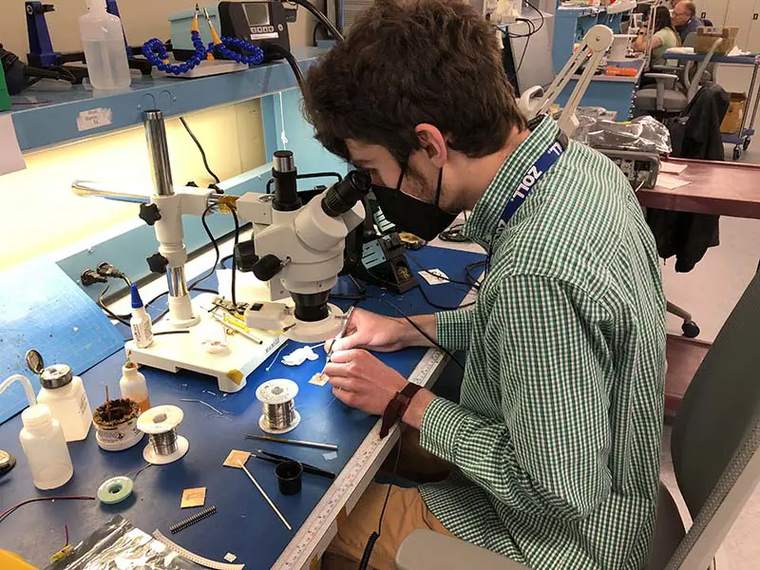
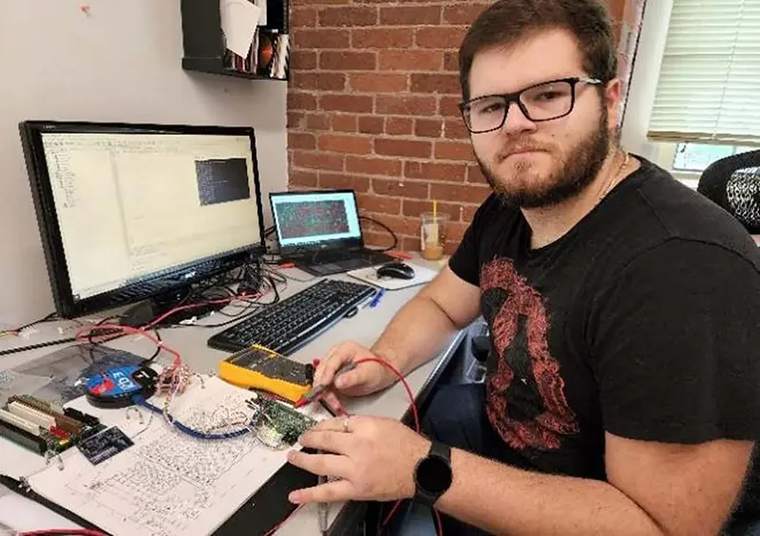
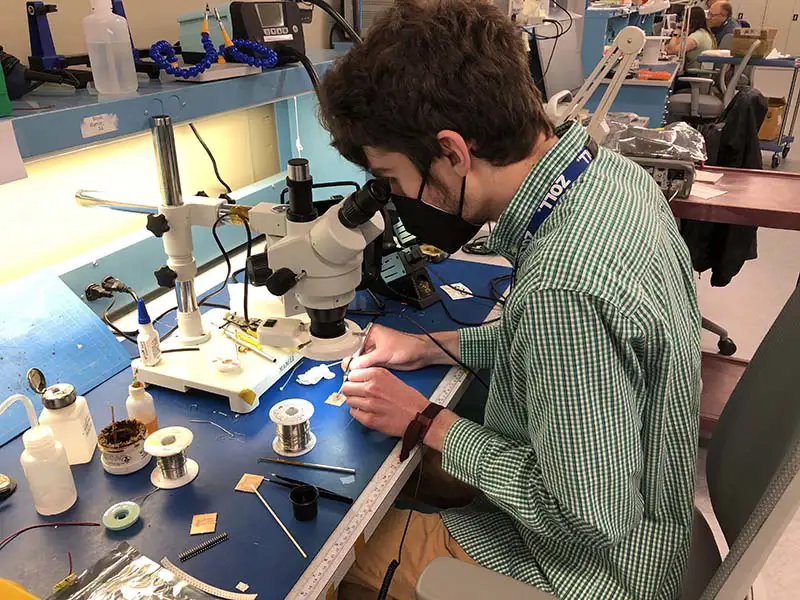
Electricical Engineering student Thomas Cecelya worked at Zoll from January to June 2022, and Allegro Microsystems, from May to August 2023.
Thomas's Co-op Role
Assist team with in-lab test setups/part exchanging
Bench-to-system analysis comparing Test engineering ATE results with Product Validation bench results for two different current sensors
Developed outline for automating the characterization of overcurrent fault behavior of current sensors
Performed verification testing of a new defibrillator product for R&D team
Designed and assembled a load termination PCB to increase robustness of EMI testing setup
Established automation of test equipment to assist with board-level debug and verification testing
Developed a working prototype device for Advanced Development team to use in NearInfrared Spectroscopy (NIRS) research
Both undergraduate and graduate students have many opportunities to participate in faculty-led research projects. Our graduates are well prepared for various roles in the industry, to design, test, analyze, optimize and manufacture products, and to develop software for countless applications. Some of our graduates become college faculty themselves.
The ECE department has a faculty of diverse expertise to conduct research and teach courses in the following areas of specialization:
AI and Robotics: manufacturing, drones, robot vacuums, lawn mowers, internet.
Communication systems: cell phones, GPS, navigation systems, teleconferencing.
Computer systems and networks: microprocessors, embedded systems, digital networks, internet, cloud storage, game consoles.
Control systems: found in all automated systems, vehicles (cars, drones, spacecraft), defense systems, robots, manufacturing, satellites, household appliances.
Power and energy: consumer grids, smart grids, solar panels, wind turbines, generators, power supplies for all electronic devices.
Signal and image processing: music players and instruments, medical imaging (CT), machine/robot vision, facial recognition, object detection, security systems.
The ECE department has well-equipped teaching labs for four core laboratory courses: Circuits I, Circuits II, Electronics I, and Electronics II. During a lab section, each student uses a complete set of testing equipment (including an oscilloscope, a signal generator, a power supply and a computer), to conduct experiments independently. All students are also given a full parts kit for learning and experimentation in and out of the classroom. These kits are for students to keep, including a wide assortment of electrical components, wire, a handheld multimeter, and a breadboard.
In addition, The ECE department has a dedicated makerspace (eMake) for ECE students to create, design and strengthen their hands-on skills.
Many other courses also have lab/programming/software components, such as Intro to ECE, Logic Design, ECE Application Programming, Microprocessors I, Microprocessors II, Advanced Digital System Design, and Computer Vision. The students use computers and microprocessors to conduct experiments, do projects in classrooms, the ECE makerspace, or off campus.
The Electrical and Computer Engineering department maintains an organized and diverse stockroom in proximity to its electronics labs. This 759 ft.² space contains passive components, wire, benchtop testing equipment, soldering equipment, and more. It serves as a central hub for students, fostering efficient time management on project completion for academic needs, including the senior Capstone Project.
Parts are organized systematically in the Stockroom App, which allows registered students to remotely browse through available options. Students can also order additional components through the app.
Students gain major design experience from a two-semester capstone sequence in the senior year: Capstone Proposal and Capstone Project. The major objective of the Capstone Proposal is for each student to define the project, including a complete set of requirements, test plan, preliminary hardware and software designs, and preliminary cost estimates. The second semester course, Capstone Project, is concerned with verification of the first semester design, subsequent redesign, final fabrication, testing, and delivery of the system to the client. Students meet with their mentors each week for project management guidance, technical support, and evaluation. The majority of course activities are project specific and are led by mentors with general guidance provided by the course instructor. There are two capstone tracks:
EECE.3991 Capstone Proposal and EECE.4991 Capstone Project: In this course sequence, students work in teams to design, build, and deliver projects in one of several areas. First are assistive technology solutions for individuals with disabilities. Second are industry sponsored projects with companies such as Raytheon and Brooks Automation. Third are faculty sponsored projects. Fourth are projects for contests such as the Collegiate Wind Competition sponsored by the Department of Energy or the Formula SAE team.
ENGN.4017 Entrepreneurship Engineering Capstone Proposal and EECE.4991 Capstone Project: The Entrepreneurial track, in collaboration with the Manning School of Business, involves the development of a prototype of a product along with the utilization of entrepreneurial analysis techniques to explore the viability of a new product idea. The first semester is taught alongside ENTR.4960 Entrepreneurship Strategy Implementation; groups will contain a mix of engineering and business students where the new product idea will be evaluated, and preliminary design work will be started. In the second semester, engineering students take the ECE department capstone where they will implement their design.
Seniors take EECE.3991 Capstone Proposal and EECE.4991 Capstone Project. In the first course, each team works with its sponsor to set the requirements and the design. In the second, the team builds, tests and delivers the system. Teams meet their faculty mentors every week.
Many teams also include students from other departments, such as Biomedical Engineering and Mechanical and Industrial Engineering.
Types of Projects
Industry sponsored: problems from companies and government labs.
The co-op program provides the students a great opportunity to enhance their employability after graduation. The students gain valuable practical work experience in electrical and computer engineering at many leading companies. They get the opportunities to demonstrate their skills and values. They are more confident and more motivated after the co-op experience.
A student takes one semester off to work full time in industry during one of the following co-op cycles:
6-plus month
Spring semester and Summer, or
Summer and Fall semester
3-month option: Summer only (at least two summers)
Preparation: Before the co-op, a student takes professional development seminar course (ENGN 2100, 1 credit) to learn
Resume writing
Strategic interviewing
Professional behavior
Presentation skills
Professional networking
Other job-hunting skills
Reflection: After the co-op, a student takes an assessment course to reflect the co-op experience, identify technical and professional skills that have learned, and to plan next steps of career development.
Benefits of Co-op Program
Helps to find an ideal job, faster, or right after graduation
Many students get full-time job offers before the co-op has ended
Best opportunity to demonstrate your skills and value
Earn an average of $26k (in 6 months), to pay a portion of tuition
Higher salary after graduation than peers without co-op
When eligible, can be counted as one technical elective course
Helps to decide future courses, career path, MS/PhD programs
Gain experience in actual work environment
Enhance critical thinking and problem-solving skills
Promote maturity
Promote networking skills
Promote teamwork
Co-op also has many benefits for companies to recruit employees and for universities to gain feedback on programs in order to adjust course materials or add new courses.
Co-op Spotlight
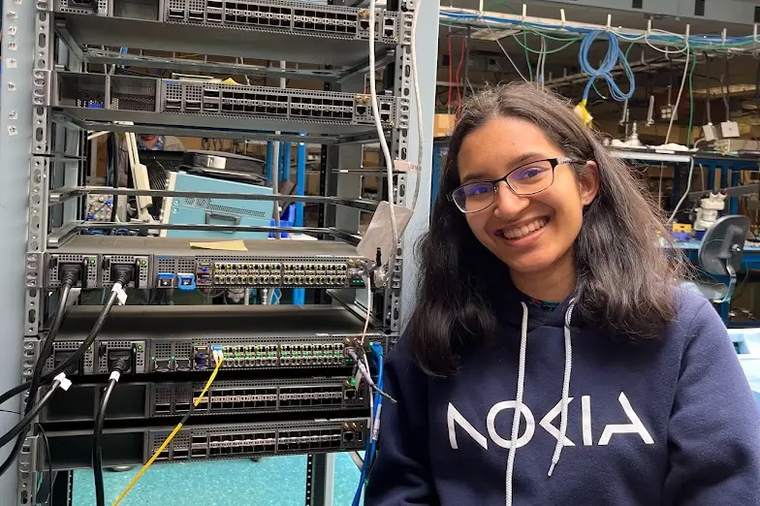
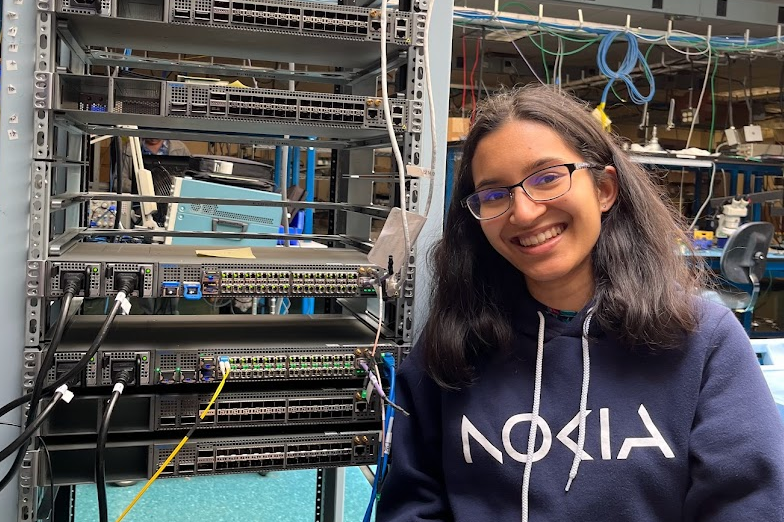
Computer Engineering student Nishi Shah worked at Nokia in Westford from Jan 2023 to June 2023.
Nishi's Co-op Role
Worked on a wide-range of v Nokia 7250 IXR-e Router products
Performed diagnostic hardware testing and troubleshooting of circuit boards
Developed and debugged Python scripts used to automate hardware testing and embedded diagnostic tests written in "C.”
Defined, documented and managed efficient test flow processes of IXRe router prototypes. Trained other co-op and technician staff to streamline project hand-off to the software development team.
Maintained and presented Microsoft Excel spreadsheets to the engineering team indicating the status of various prototypes.
Dozens of ECE students work in co-op positions each year at top employers in the region. The co-op experiences often result in our graduates finding their ideal jobs before or soon after graduation.
Co-ops also allow companies to recruit employees and for universities to gain feedback on programs in order to adjust course materials or add new courses.
Here are just a few of our success stories.
Co-op Spotlight
Electrical Engineering student Joe Abi Samra worked at Lowell Digisonde International during Summer 2022.
Joe's Co-op Role
Tested and troubleshot DPS4D systems at both the component and system level to help prepare them for shipment to customers.
Developed an I2C library for the PIC24FJ microcontroller for use in conjunction with a temperature sensor.
Wrote and revised documentation for various system test procedures.
Developed an I2C library for the PIC24FJ microcontroller for use in conjunction with a temperature sensor.
Wrote microcontroller firmware to control band selection for the Digisonde harmonic filter.
Tested and developed PIC24FJ firmware for communication with a DAC and band control on a variable band pass filter card for next generation Digisonde.
Developed a user-interactive Python Script that filters through antenna modeling output text files for pertinent data and stores them into excel documents.
Modeled and varied design parameters of a scaledup version of the LDI antenna to optimize it for highest broadband vertical gain for a customer.
Student
Co-op Company
Date of Graduation
Full-time Employment
Julia Atkins
National Grid
May 2023
National Grid since Sept. 2022
Noel Duro
BAE Systems
May 2023
BAE since June 2023
Jessica DeBruin
MACOM
May 2023
MACOM since June 2023
Siddhartha Shrestha
Microchip Tech. (Microsemi)
May 2023
Raytheon since June 2023
Delbert Edric
Analog Devices
Dec. 2022
Analog Devices since Jan. 2023
Joe Abi Samra
Alert Innovation
Dec. 2022
Alert Innovation since Jan. 2023
Noah Bell
Alert Innovation
Dec. 2022
Alert Innovation since Jan. 2023
Luke Heider
Vicor Corporation
May 2022
Brown & Caldwell since June 2022; Rapid Micro Biosystems since Feb. 2023
Find, join and contact every registered club on CampusGroups (UMass Lowell login). The clubs below are the ones ECE students join most. Club members can also build their projects in the ECE Makerspace.
Build and compete
Drone Club
Build drones from parts, learn to fly them, and learn the rules that govern flying them.
The department also hosts its own activities each semester, like the Fox Hunt below.
During a recent “Fox Hunt” activity, students had fun while practicing engineering technology. Using a microwave analyzer, teams competed to locate red objects (“foxes”) hidden at various locations on campus (under a rock, in a flowerbed or tree branch, under a chair, etc.).
Creation, Innovation and Networking
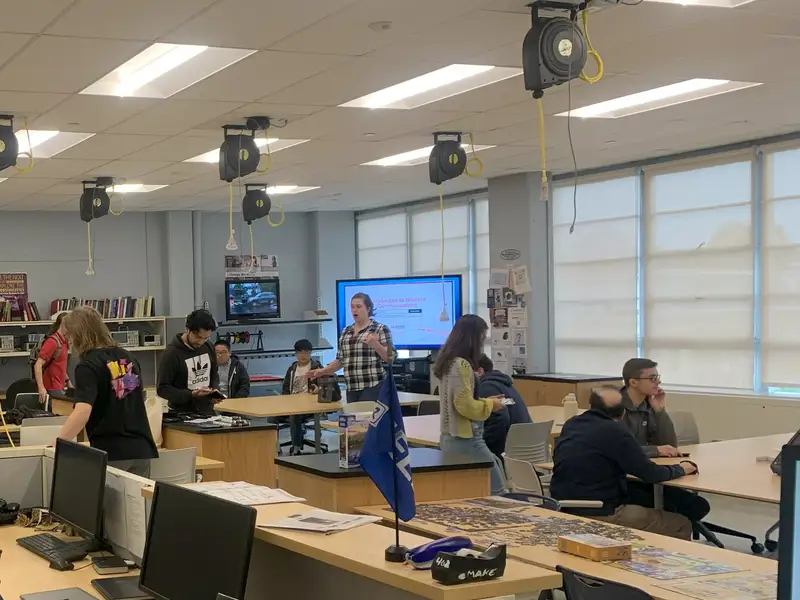
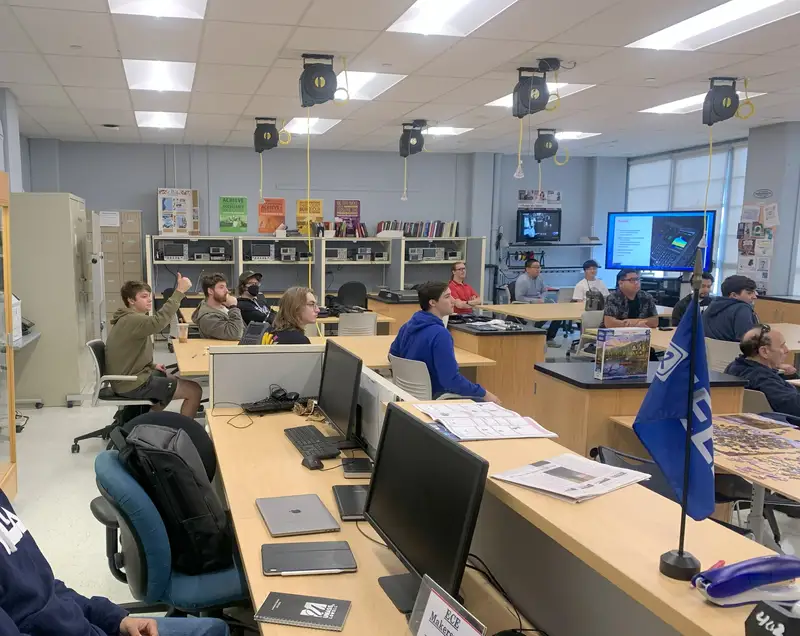
The ECE Makerspace (eMake) is where ECE students create, design and sharpen their hands-on skills.
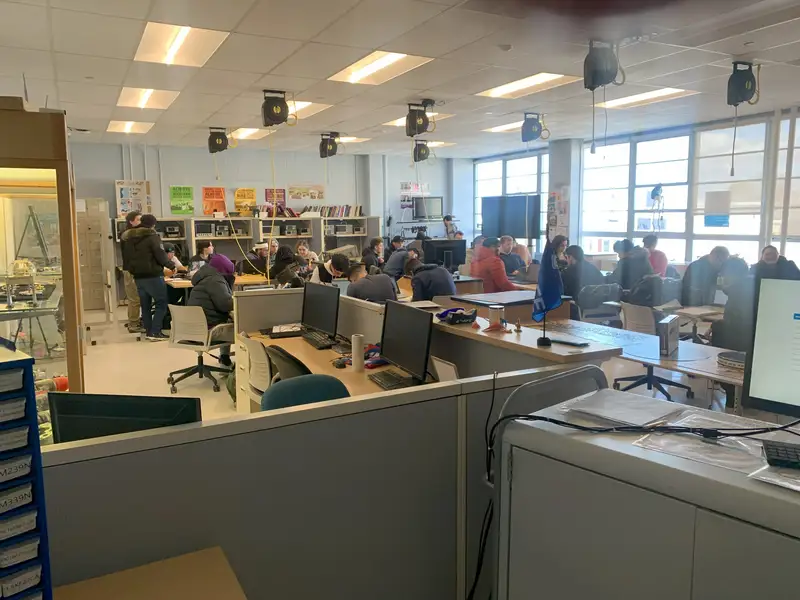
The 1,879-square-foot space is used for teaching, labs, projects and student activities, and it is a welcoming place to learn, build, get together and help each other. eMake provides test equipment, parts and supplies for circuit design and construction, and many students build their capstone and course prototypes here. Weekly co-op office hours are held here too.
A capstone team controls a drone with head motion, captured by a computer camera that sends control signals to the drone.
Tell us what you have in mind: a senior project, co-op hiring, sponsored research, the advisory board or our facilities. The chair's office will connect you with the right people.
Since 1991, senior capstone teams in the Assistive Technology Program have designed and built custom devices for clients with disabilities. People across New England send in a need, and a student team works with a faculty adviser to build a device that meets it. More about senior capstone projects.
1991
Year the program began
1,500+
Custom products delivered to clients
In 2000 the program was named a Daily Point of Light and received the Manuel Carballo Governor's Award for public service. It welcomes new clients and volunteers.
Outreach and support for future engineers in the community.
Working With Regional Industry
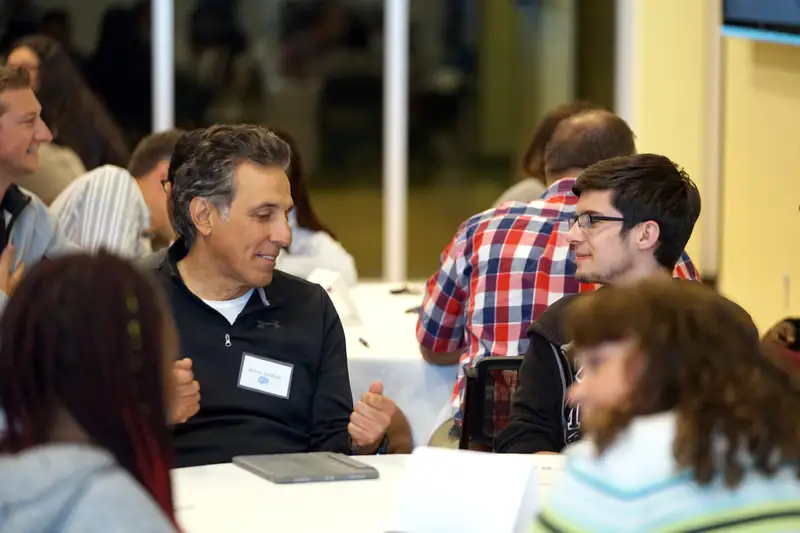
Most of our graduates go into industry, many with companies within 100 miles of Lowell. Engineers from 14 companies and agencies advise the department through the Industrial Advisory Board, and more than 100 companies hosted ECE co-ops in the past five years.
Nine of the 11 recent graduates below went to work full time for the company where they did their co-op.
Julia Atkins
Graduated May 2023
Co-opNational Grid
→
Full timeNational Gridsince Sept. 2022
Noel Duro
Graduated May 2023
Co-opBAE Systems
→
Full timeBAE Systemssince June 2023
Jessica DeBruin
Graduated May 2023
Co-opMACOM
→
Full timeMACOMsince June 2023
Siddhartha Shrestha
Graduated May 2023
Co-opMicrochip Technology (Microsemi)
→
Full timeRaytheonsince June 2023
Delbert Edric
Graduated Dec. 2022
Co-opAnalog Devices
→
Full timeAnalog Devicessince Jan. 2023
Joe Abi Samra
Graduated Dec. 2022
Co-opAlert Innovation
→
Full timeAlert Innovationsince Jan. 2023
Noah Bell
Graduated Dec. 2022
Co-opAlert Innovation
→
Full timeAlert Innovationsince Jan. 2023
Luke Heider
Graduated May 2022
Co-opVicor
→
Full timeBrown & Caldwell, then Rapid Micro BiosystemsJune 2022, then Feb. 2023
Konstantin Vostrikov
Graduated Dec. 2021
Co-opGE Aerospace
→
Full timeGE Aerospacesince April 2022
Rabindra Neupane
Graduated Dec. 2021
Co-opZOLL Medical
→
Full timeZOLL Medicalsince Feb. 2022
Jacqueline Giggi
Graduated May 2021
Co-opDell Technologies
→
Full timeDell EMCsince June 2021
Where Our Students Work
104 companies hosted ECE co-ops in the past five years, and 59 more have hired our graduates.
Co-op employers in the past five years
Abiomed
Acacia Communications (now part of Cisco)
Affirmed Networks
AHA Consulting Engineers
Allegro MicroSystems
AMD
Analog Devices
Arista Networks
ASMPT NEXX
Axcelis Technologies
BAE Systems
BLW Engineers
Bose
Cargill
Carrier
CDM Smith
Celera Motion
Charles River Development
Cisco
Covaris
DAPR Engineering
Dell Technologies
Diversified Technologies
Draeger Medical Systems
Draper
E Ink
Edwards Vacuum
Endeavor Robotics
Entegris
Enterprise Bank
Eversource Energy
Extreme Engineering Solutions
FARM
FIS
Flex
Fractal Antenna Systems
GE Aerospace
General Dynamics Electric Boat
General Dynamics Mission Systems
Geophysical Survey Systems
Getinge
GraVoc
HCLTech
Hologic
Hubbell
IDEMIA
indie Semiconductor
Infineon Technologies
Insulet
iRobot
J&M Brown
Lowell Digisonde International
MACOM
Mercury Systems
Methods Machine Tools
Microchip Technology (Microsemi)
MicroPort
MIT Lincoln Laboratory
MITRE
MKS Instruments
NASA
National Grid
Nederman
Nokia
NxStage Medical
Osram
Parker Hannifin
PerkinElmer
Pfizer
Philips
PolyJoule
Portsmouth Naval Shipyard
Proveris Scientific
QA Technology
QinetiQ
Qlibrium (formerly Cam-Med)
Red Hat
Resonetics
RISCO USA
Riverside Research
Rochester Electronics
Rockwell Automation
RTX (Raytheon)
Schneider Electric
SI2 Technologies
Signify (formerly Philips Lighting)
SimpliSafe
Skyworks Solutions
Sonos
Spica Technologies
Symetrica
Synopsys
Teledyne FLIR
Teradyne
Textron Systems
Thermo Fisher Scientific
Third Pole Therapeutics
UKG (Ultimate Kronos Group)
Veoneer
Viasat
Vicor
Vivonics
Wayfair
ZOLL Medical
59 more companies that have hired our graduates
ABB
Advantage Components
Aerodyne Research
Agero
Anaren Ceramics
Apple
ASM
athenahealth
Bitwave Semiconductor
Boeing
Brooks Automation
Burns & McDonnell
Canobie Lake Park
Communication & Power Industries
Crane Co.
Crossbeam Systems
Degree Controls
Elm Electrical
Fairfield Service Co. of Indiana
Game Creek Video
GE Appliances
General Dynamics
Goodrich
Haemonetics
Hanscom Air Force Base
Hittite Microwave
IBM
Intel
IPG Photonics
Juniper Networks
Kadient
Levant Power
Lifeline
MagneMotion
Masy BioServices
Mia Solutions
NES Technologies
New Energy Options
PSNH
Putnam Investments
RadioWaves
Raytheon BBN
RDK Engineers
RF Integration
SpaceX
Suntron
Synclear Technology Group
SynQor
TE Connectivity
U.S. Air Force
U.S. DOT Volpe Center
Ultimate Solutions
United Technologies
Valeo Raytheon Systems
Varian Semiconductor
Vector Controls
Veroxity Technology Partners
Westford Public Schools
Wyeth BioTech
Hire Our Students
Post co-op and full-time positions through the UMass Lowell Career & Co-op Center. Six-month co-ops run January to June or July to December, and summer co-ops run June to August.
When humans and artificial intelligence disagree on the best strategy to pursue in a high-stakes situation, can working through their differences lead to better decisions? A group of UMass Lowell faculty has won a $971,874 Army grant to explore human-AI misalignment.
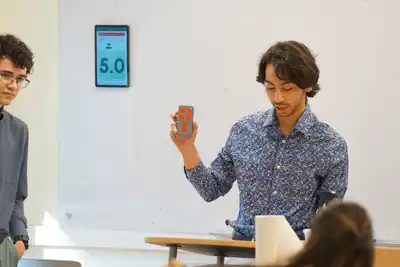
Jetrin Orenberg ’26 has turned his DifferenceMaker-winning Comprehension Clicker from a rough prototype into a startup aimed at helping professors better understand when students are struggling in class.
UMass Lowell’s six-week RAMP summer program gives incoming Francis College of Engineering students an early start on college through coursework, research, industry mentoring and community-building.
Over the past four years, the National Science Foundation has recognized 12 UMass Lowell faculty researchers as some of the nation’s best junior, tenure-track scholars by awarding them prestigious Faculty Early Career Development (CAREER) grants.
Electrical and Computer Engineering Professor Hualiang Zhang is part of an international research team that has won National Science Foundation funding to develop faster wireless communications in the terahertz range of the electromagnetic spectrum.
Professor of Electrical and Computer Engineering Alkim Akyurtlu was recently named a NextFlex fellow for her leadership and contributions to the field of hybrid electronics manufacturing.
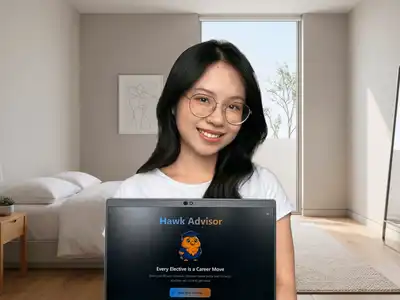
Computer science graduate Jessica Vu ’26 created Hawk Advisor, an AI-powered website that helps UMass Lowell students explore career paths and choose electives that align with their professional goals.
UMass Lowell students from majors spanning computer science, engineering, economics and business are gaining hands-on experience through co-ops at Fresenius Medical Care, contributing to the development of home dialysis technology.
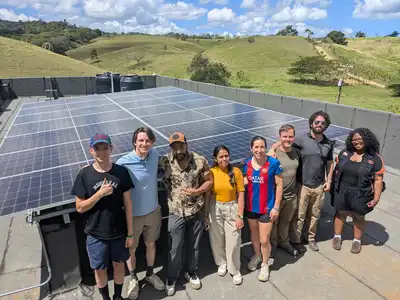
Eight students completed a mechanical engineering directed study during the spring semester, which included a one-week trip to Sosúa, Dominican Republic, where they installed solar panels for those without reliable electricity.
UMass Lowell’s chapter of the international honor society of the Institute of Electrical and Electronics Engineers, IEEE-Eta Kappa Nu, has won national recognition for its activities and impact on campus.
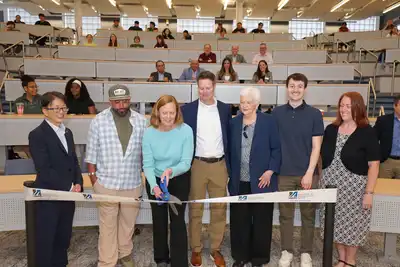
UMass Lowell has named a newly renovated Ball Hall lecture hall and established a professorship in honor of computing pioneer Edson deCastro ’60, ’78 (H), funded by a gift from his family.
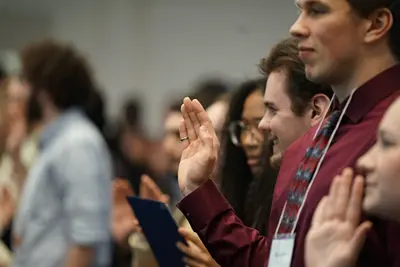
Nearly 100 Francis College of Engineering seniors took the Order of the Engineer oath at a ceremony where plastics engineering alumna Charlotte Ward ’13 urged them to lead with integrity.
A team of engineering and physical therapy faculty and students is collaborating to on research to evaluate the accuracy of how augmented reality technology tracks joint motion and hand gestures.
A device that makes permanently mounted window bars fire-safe by allowing residents to release them instantly in an emergency won the annual Francis College of Engineering Prototyping Competition, hosted by the Rist DifferenceMaker Institute.
UMass Lowell’s Shah Academy of Innovation and Leadership welcomed a new cohort of engineering scholars as the inaugural class reflected on a transformative first year of mentorship, professional development and leadership training.
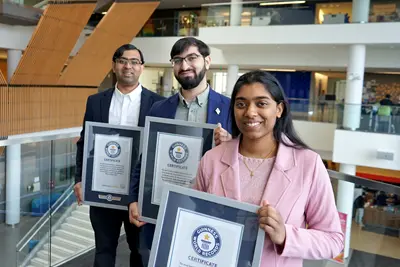
Siblings Martin, Justin and Jasmin Marwad, who earned bachelor’s degrees in 2023 and master’s degrees in 2024, recently made it on to the Guinness World Records list for their degree-earning prowess.
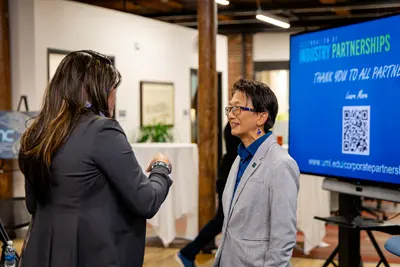
The Celebration of Industry Partnerships, held in the heart of the Lowell Innovation Network Corridor, recognized more than 160 organizations that work with UMass Lowell.
Electrical Engineering Assistant Professor Anhar Bhuiyan has won two National Science Foundation grants for his research into better materials and electronic devices for high-voltage power components used in space – and here on Earth.
New Francis College of Engineering Dean Susan Roberts, a chemical engineer with a distinguished career advancing interdisciplinary research and graduate education, is excited to lead the college through a new era of research, innovation and collaboration.
Thirteen UMass Lowell undergraduate students are participating in a paid summer internship program with Science Applications International Corporation (SAIC), a global leader in technology integration and a partner in the Lowell Innovation Network Corridor.
One of the newest members of the university’s electrical engineering faculty, Assistant Professor Anhar Bhuiyan, has won a prestigious seed grant to support his research into better materials for the components that power satellites and unmanned spacecraft.
The MassRobotics Jumpstart Fellowship Program provides opportunities for high school girls in Massachusetts to learn about careers in robotics. The program, which originated in Boston in 2021, expanded to UMass Lowell in 2024 with support from the Massachusetts Tech Collaborative.
UMass Lowell students have a new place to flex their skills and imagination, thanks to Brooks Automation Inc., which has committed to create a new makerspace at the university.
The Shah Academy of Innovation and Leadership is helping select engineering students to develop into future industry leaders through scholarships, mentorship and professional skill-building opportunities.
UMass Lowell student teams, including Mock Trial, a cyber security team, Model United Nations (U.N.) and an investment class, are on a winning streak this year.
Nearly 130 seniors and alumni from the Francis College of Engineering were inducted into the Order of the Engineer, a national association that emphasizes pride and responsibility in the engineering profession.
David Laurello ’81, ’88, former CEO of Stratus Technologies, has returned to his alma mater as executive in residence at the Manning School of Business, mentoring students, teaching courses and bridging the gap between academia and industry.
Students showcased innovative solutions to real-world problems at the Rist DifferenceMaker Institute’s annual Engineering Prototyping competition, with winning projects addressing classroom feedback, adjustable prosthetics, blast detection and human rights monitoring.
Philosophy Chair Nicholas Evans and Criminology Assoc. Prof. Neil Shortland are researching the future of artificial intelligence in warfare and policy under a pair of Department of Defense Minerva Grants worth $4.2 million, leading teams that include paid student researchers and other UML and outside faculty.
Prof. Hengyong Yu of the Department of Electrical and Computer Engineering has been elected a fellow of the Institute of Electrical and Electronics Engineers (IEEE) and the American Association of Physicists in Medicine (AAPM).
The Kennedy College of Sciences’ Undergraduate Design Project, which connects students with companies to work on real problems, sets up a pathway for students to get full-time jobs.
Ten students recently completed UMass Lowell’s Innovative Fellows Training (LIFT), a new program supported by a five-year, $1.2 million grant from the National Institute on Aging that is designed to diversify career opportunities for early-career scientists in the field of aging and aging-related diseases.
The Robotics Club is looking to make a difference in people’s lives with its robotic guide dog invention, which the club has entered into the SICK $10K Challenge and the Rist DifferenceMaker Institute’s $50K Idea Challenge.
A $4 million state grant will pay for the university to set up broadband internet access in disadvantaged areas of Lowell, Fitchburg and Haverhill. The grant, part of a state effort to promote digital equity, is also paying UMass Lowell students to teach basic computer skills to older and low-income residents.
The state has awarded UML a $500,000 grant to help establish the Massachusetts Electronics Manufacturing Evolution (MEME) Laboratory to train students and industry workers in the design and fabrication of PCBs.
The National Science Foundation has awarded a three-year, $1 million grant to a team of researchers led by Electrical Engineering Prof. Yan Luo to develop a data analytics platform that uses biosensors to detect harmful organisms such as Vibrio and Pseudomonas in aquaculture farms and coastal waters.
Prof. Hengyong Yu of the Department of Electrical and Computer Engineering has been awarded a four-year, $2.3 million grant by the National Institutes of Health’s National Institute of Biomedical Imaging and Bioengineering to help improve the image quality and resolution of photon-counting computed tomography (CT) scans.
UMass Lowell is leading a project to establish a first-of-its-kind advanced manufacturing technologist training program to support the workforce needs of the aerospace and defense industries in Massachusetts.
A team of researchers led by Electrical and Computer Engineering Prof. Hengyong Yu is developing technology that would greatly improve cardiac CT scans, which doctors currently use to diagnose cardiovascular diseases.
Siblings Martin, Justin and Jasmin Marwad will be receiving bachelor’s degrees in computer science and electrical engineering when they cross the Commencement stage.
Assoc. Prof. Neil Shortland and a team of interdisciplinary researchers are looking at using artificial intelligence modeled after human attributes to make decisions in extreme situations.
A team of researchers headed by Electrical and Computer Engineering Prof. Kavitha Chandra is developing interdisciplinary programs that target graduate education and future workforce training in using digital technologies for automotive and manufacturing industries.
ARTritech Digital Health, a startup that is developing a patch for continuous blood pressure monitoring, won UMass Lowell’s inaugural Sensor Challenge at the Innovation Hub.
The National Science Foundation (NSF) has named Lara Thompson ’03 as one of three recipients of this year's Alan T. Waterman Award, the nation's highest honor for early-career scientists and engineers.
A team of faculty researchers led by Biomedical Engineering Asst. Teaching Prof. Yanfen Li has been awarded a six-year grant totaling nearly $1.5 million by the National Science Foundation to create a diverse and competitive pool of students who could become future faculty candidates in engineering.
A team of electrical and computer engineering students set out to develop a more user-friendly version, or distribution, of Fedora, a popular open-source software operating system, as part of its senior capstone project.
Asst. Prof. Yuzhang Lin was recently awarded a five-year, $500,000 faculty early-career development grant by the National Science Foundation to conduct a study that will help better predict and visualize power distribution capacity and consumers’ power demand in real time.
The Rist Institute for Sustainability and Energy has awarded 2021-22 fellowships to Assoc. Prof. of Electrical and Computer Engineering Cordula Schmid, Analytical Chemistry Ph.D. candidate Elizabeth Farrell and chemical engineering major Andrew Parker.
Assoc. Prof. Joyita Dutta of the Department of Electrical and Computer Engineering has been awarded a $2.7 million grant from the National Institutes of Health (NIH) for research that could help shed light on the progression of Alzheimer’s disease.
SPACE HAUC, UMass Lowell’s first satellite, recently passed a critical test that cleared the way for its upcoming launch into Earth orbit. The satellite was designed and built by more than 100 students from the Kennedy College of Sciences and the Francis College of Engineering over the course of five years.
The UTeach program, which turns science, math and engineering majors into classroom teachers, is now in its 10th year at UMass Lowell. Graduates are in great demand at local high schools, and one was named a finalist for Massachusetts STEM Teacher of the Year.
Mechanical Engineering Prof. and Dept. Chair Christopher Niezrecki has been named the 2020 Distinguished University Professor for exemplary teaching, research and service to the university.
The U.S. Department of Energy has awarded researchers from the Department of Electrical and Computer Engineering a three-year, $500,000 grant to develop a new, wireless high-temperature sensor network for smart, coal-fired boilers used in industry.
Students who miss being on campus — and incoming freshmen who want to meet fellow River Hawks outside of the remote classroom this fall — can connect virtually on HawkCraft, the university’s official Minecraft server.
Two dozen incoming first-year and transfer students got a jump on their engineering studies — and a preview of college life during the coronavirus pandemic — through the Francis College of Engineering’s Research, Academics and Mentoring Pathways (RAMP) program.
The River Hawk Rising program provides structured support and a personal connection to students of color, transfer students and first-generation students during their time at the university, setting them up for success in college and beyond.
Rover the River Hawk, an Industrial Capstone Senior Design project that Engineering students are building to clean debris from the city’s canals, received a Green Design award from the Lowell Sustainability Council and a Certificate of Special Congressional Recognition from U.S. Rep. Lori Trahan.
To help protect medical information from cyberattacks, the National Science Foundation has awarded a three-year grant totaling nearly $1 million to a team of researchers led by Prof. Yan Luo of UMass Lowell’s Department of Electrical and Computer Engineering to develop a secure cyberinfrastructure for translational research.
U.S. Rep. Lori Trahan learned about the latest technology used in parachutes and other battlefield innovations while touring the HEROES lab on Feb. 20.
The National Science Foundation has awarded nearly $1 million in grant to a team of researchers led by Prof. Yan Luo to develop a secure and compliant cyberinfrastructure for translational research.
Visit or write
Department of Electrical and Computer Engineering Ball Hall, Room 301 University of Massachusetts Lowell One University Avenue Lowell, MA 01854
Electrical and Computer Engineering Professor Hualiang Zhang is part of an international research team that has won National Science Foundation funding to develop faster wireless communications in the terahertz range of the electromagnetic spectrum.
Professor of Electrical and Computer Engineering Alkim Akyurtlu was recently named a NextFlex fellow for her leadership and contributions to the field of hybrid electronics manufacturing.
UMass Lowell’s chapter of the international honor society of the Institute of Electrical and Electronics Engineers, IEEE-Eta Kappa Nu, has won national recognition for its activities and impact on campus.
Electrical Engineering Assistant Professor Anhar Bhuiyan has won two National Science Foundation grants for his research into better materials and electronic devices for high-voltage power components used in space – and here on Earth.
Save time and money by earning a bachelor's and a master's degree in as little as five years.
ABET Accreditation
The Electrical Engineering program is accredited by the Engineering Accreditation Commission of ABET under the commission’s General Criteria and Program Criteria for Electrical Engineering.
Save time and money by earning a bachelor's and a master's degree in as little as five years.
ABET Accreditation
The Computer Engineering program is accredited by the Engineering Accreditation Commission of ABET (Accreditation Board for Engineering and Technology) under the commission’s General Criteria and Program Criteria for Computer Engineering.
For an optimum web experience we recommend the latest version of Firefox, Chrome, Edge, or Safari. Please use one of the links below to install a supported browser.